eCoreX boosts grinding efficiency with AI-based methods
News
By leveraging existing drill core material and combining it with new measurement techniques and advanced simulation, eCoreX is taking ore forecasting to a new level. The research project points to significant potential for more energy-efficient and predictable grinding.
The project AI Methods for Linking Mineralogy and Drill Core Sawing to Grinding Efficiency (eCoreX) was carried out between November 2024 and May 2025. The pre-study was one of the projects funded in the first calls launched by Swedish Metals & Minerals.
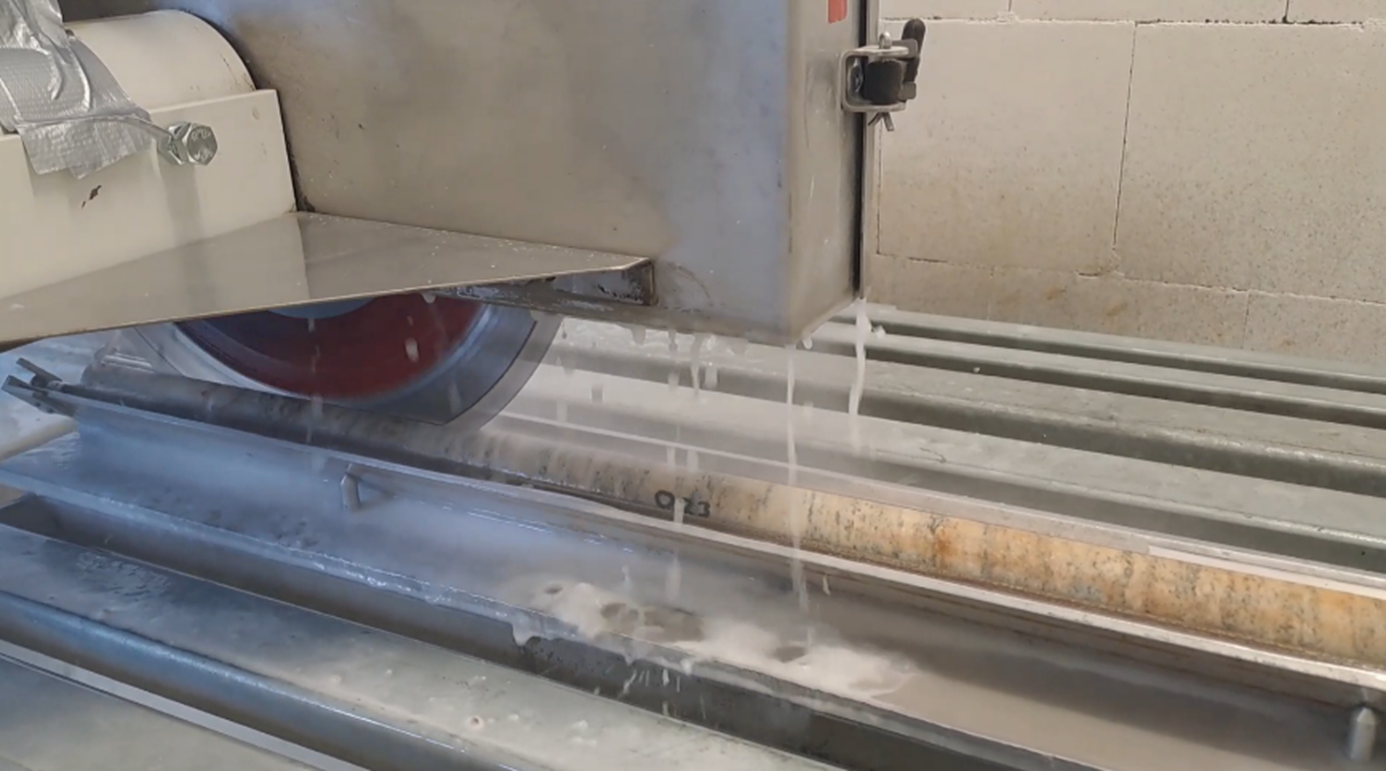
eCoreX addresses a central challenge in the mining industry: finding faster and more cost-effective ways to predict how ore will behave in crushing and grinding processes. Mines extract large volumes of drill cores to map ore bodies and support investment and operational decisions. To enable analysis, all drill cores are split using a diamond saw. The project’s core idea was to investigate whether the energy used during sawing could be measured and, together with other types of data, be used to predict ore strength—and thereby the cost of downstream crushing and grinding.
Because traditional tests for grindability and strength are costly, they are often conducted only to a limited extent, leaving mining companies with too few datapoints and high uncertainty in their forecasts.
“We wanted to explore whether re-using the work already invested in drill core handling, combined with new measurement techniques, AI and advanced simulation, could unlock an entirely new level of predictive capability,” says Johannes Quist, researcher at the Fraunhofer-Chalmers Centre and project manager for eCoreX.
The vision can be described as moving from a single value intended to represent one or several million tonnes of ore, to a value for every metre of drill core—a radical increase in data density. Such a development would be highly valuable for energy-efficient and sustainable metal production, and for future raw materials supply. With better predictions, energy use, equipment wear and production uncertainty can be reduced, while enabling more precise operational planning.
The project aimed to assess whether it is possible to combine drill core measurement data—such as sawing energy, strength tests, hardness and mineral composition from XRF scanning—with advanced DEM modelling to predict crushing and grinding properties at an early stage.
Along the way, the project encountered several challenges. One was integrating many different data types while ensuring that each measurement point truly matched the correct depth and position along the core. To manage this, the team developed a new data structure with a resolution of 2-centimetre intervals. Another challenge was the time and cost of uniaxial compression tests on intact cores—tests that ideally should have been far more numerous. This issue will now be addressed in the project’s successor, the newly approved full-scale project CoreX2.
According to Johannes Quist, collaboration within the consortium has been one of the project’s major strengths. Boliden contributed as an active problem owner and driving partner, and to keep pace with the ambitious timeline, the team worked iteratively. As core boxes progressed through the experimental plan, the dataset gradually grew, enabling researchers in data analysis, AI and simulation to begin early and continuously improve the models as more data became available.
“The pre-study shows that combining drill core data, AI and advanced modelling holds strong potential. The project has resulted in promising correlations, a functioning testing methodology and a shared long-term vision. At the same time, we have learned the importance of meticulous data collection and gained insight into what needs to be done differently—particularly finding ways to increase the amount of strength data, ideally through tests on half-cores,” says Quist.
The work carried out in the pre-study now forms the foundation for the full-scale project eCoreX2. In the next phase, Luleå University of Technology will join the project group, as will LKAB as a new problem owner with a different type of ore and extensive operational experience. The plan is to scale up measurements—initially still in a laboratory environment, while building capacity for measurements in production settings. This will enable stronger datasets and allow the models to be verified and validated at a higher TRL level. In the long term, the hope is that this work will pave the way for new decision-support tools that strengthen the sustainability of future raw materials supply.
Project partners: Fraunhofer-Chalmers Centre (FCC) and Boliden.
Images: Drill core from a project meeting at Fraunhofer IEG in Bochum, and the saw in action.