Metallic Materials concluded with a well-attended Program Conference
News
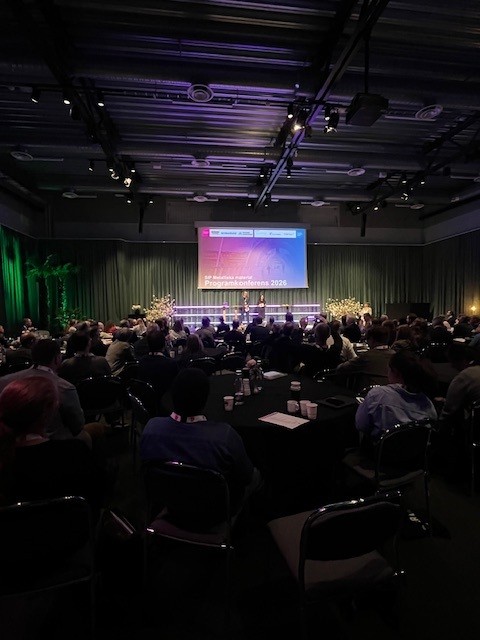
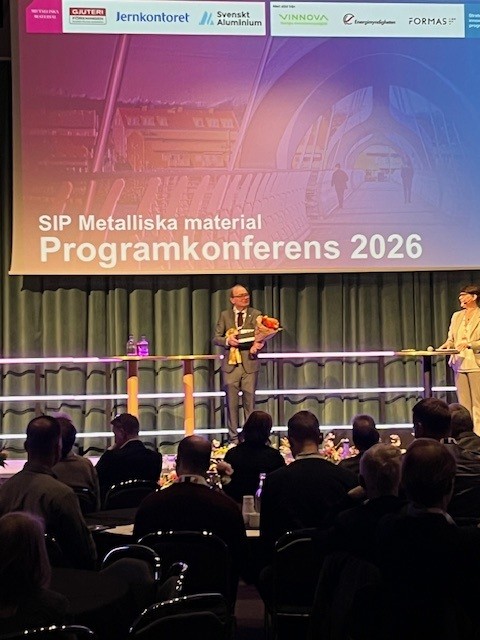
On 11–12 March, around 170 participants gathered as the strategic innovation program Metallic Materials held its final Program Conference. Over two days, the conference looked back on 12 years of research and collaboration while also looking ahead to the challenges and opportunities facing the Swedish metals industry and metals research.
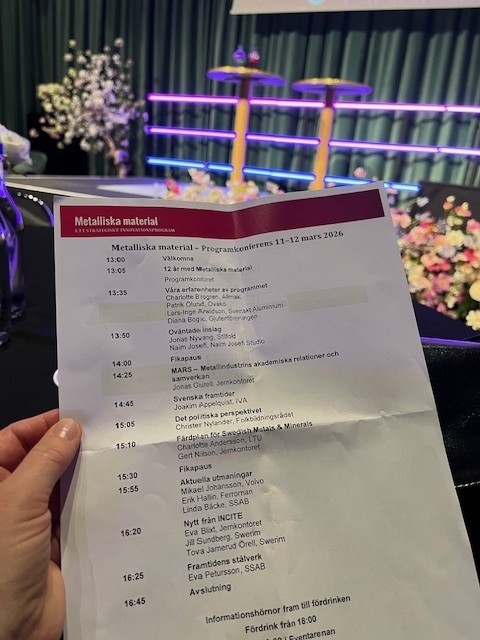
The first day began with moderator Karin Klingenstierna welcoming participants to the conference. The Metallic Materials program office then took the stage to present an in-depth retrospective of the program’s 12 years and to introduce the newly released 12-year report, which all participants received at check-in. Particular attention was given to the program’s 251 funded research projects, SEK 649 million in support from the funding agencies, and SEK 655 million in co-funding. Together, these figures clearly demonstrate the impact and success of Metallic Materials as a research program.
Next on stage were Patrik Ölund of Ovako, Diana Bogic of the Swedish Foundry Association, and Lars-Inge Arwidson of Svenskt Aluminium, who shared their experiences of Metallic Materials and reflected on what the program has meant for research within their companies and organisations. The segment both opened and closed with a short video greeting from Charlotte Brogren of Alimak, who was involved when Metallic Materials was launched in her role as Director General of Vinnova at the time.
Metallic Materials has also supported projects beyond traditional research. Jonas Nyvang of Stilfold joined Karin Klingenstierna for a conversation about how the company grew out of the Metallic Materials project Stilride, and how its innovative way of folding materials has attracted interest from major industrial companies around the world. Fashion designer Naim Josefi then spoke about working with unexpected and unconventional materials, describing how he, together with Metallic Materials, realised his vision of using metal as a material in fashion design.
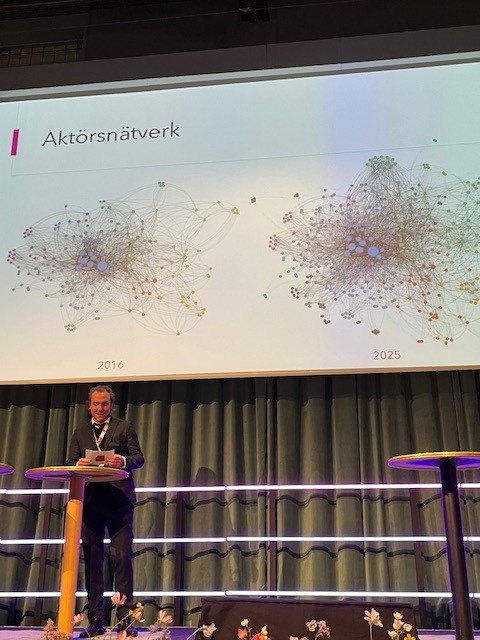
Jonas Gurell of Jernkontoret presented the MARS project – Academic Relations and Collaboration in the Metals Industry. The project has examined how the system is structured, how relationships function, and where connections and development potential can be found. Several interesting patterns and results were highlighted.
Joakim Appelqvist of the Royal Swedish Academy of Engineering Sciences (IVA) spoke about Swedish Futures, a broadly anchored vision for Sweden as a leading innovation and technology nation by 2035. Swedish Futures focuses on competitiveness, sustainability and security, and aims to generate knowledge in crucial areas, create a meeting place for experts and decision-makers, formulate visions for Sweden, and identify the decisions required to achieve them.
Christer Nylander then took the stage to provide a political perspective on research. A former Member of the Swedish Parliament for the Liberal Party, he has also served on the Committee on Education and been the Government’s special investigator on adult education policy. Among other topics, he highlighted the role of politics in promoting research, current political challenges, the importance of long-term perspectives in research policy, and what industry can contribute to politics.
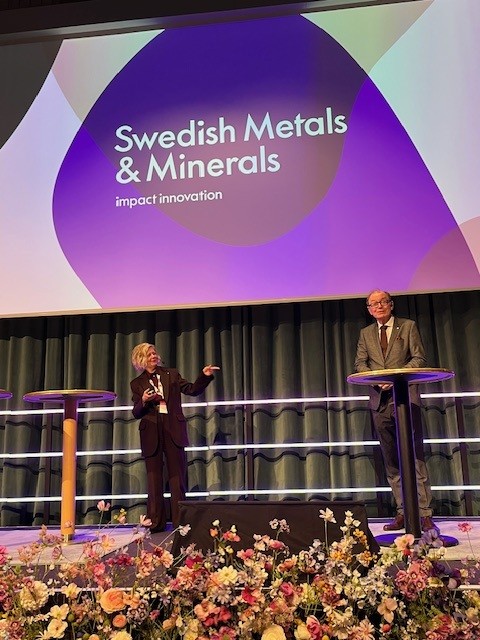
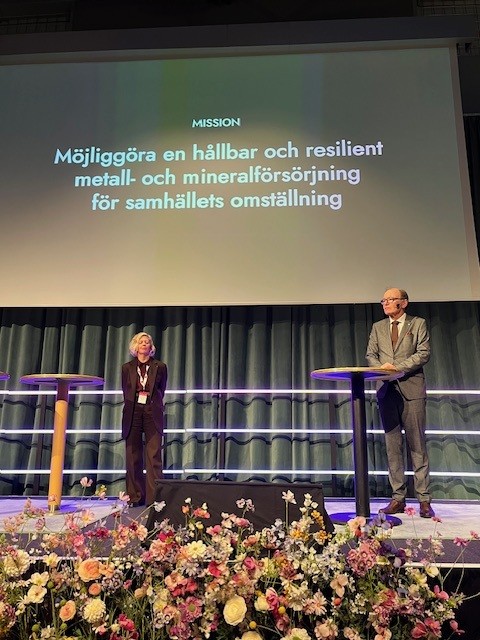
Swedish Metals & Minerals will soon be launching a roadmap. Gert Nilson of Jernkontoret and Charlotte Andersson of Luleå University of Technology presented the roadmap and its content. It outlines the steps required for the research program to achieve its mission and the challenges that must be addressed along the way.
There is no shortage of challenges within industry. Mikael Johansson of Volvo Powertrain Engineering, Erik Hallin of Ferroman, and Linda Bäcke of SSAB described the current challenges facing their respective companies. Mikael Johansson focused on Volvo’s extensive project in Skövde, which is set to significantly reduce the plant’s environmental impact. Erik Hallin addressed digitalisation, highlighting both key obstacles and factors for success. Linda Bäcke presented the research challenges SSAB faces in its transformation, where blast furnaces and coke plants are being replaced by new technology. These changes mean that new areas of research need to be strengthened and that new research expertise may also be required.
Eva Blixt of Jernkontoret, Jill Sundberg of Swerim, and Tova Jarnerud Örell of Swerim spoke about the EU innovation platform INCITE and the Impact Incite project. They presented the project report, which shows how Swedish industrial companies can benefit in concrete ways from engaging early in the EU’s work on industrial transition.
The final keynote speaker was Eva Petursson of SSAB, who highlighted SSAB’s groundbreaking green transition and described how the steelworks of the future will operate. She explained how what began as a future vision for the company is now approaching reality, and the difference SSAB’s products can make both today and in the future. She also spoke about the technological developments already underway and those still ahead.
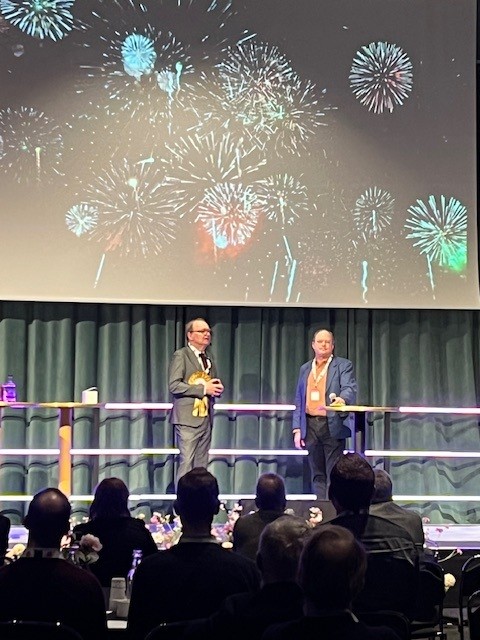
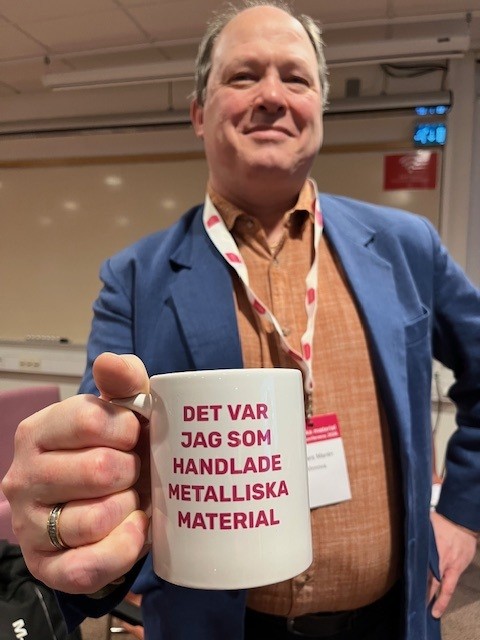
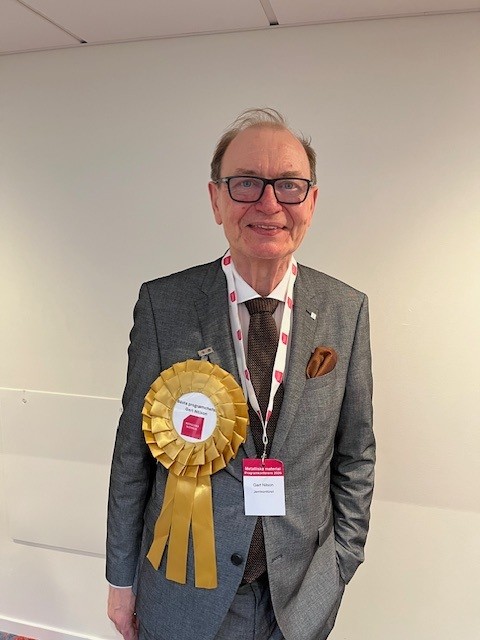
The first day of the conference concluded with members of the Metallic Materials board thanking an emotional Gert Nilson, Program Director of Metallic Materials, and presenting him with flowers, a beautiful ribbon and, fittingly, a lump of iron. Gert Nilson, Lotta Sörlin and Rasmus Östlund from the program office then took the stage to thank all project leaders, project support staff, Agenda Council members, and everyone who has taken part in projects during Metallic Materials’ 12 years. Final thanks were also extended to Anders Marén, Vinnova’s program officer for Metallic Materials. According to Gert Nilson, Metallic Materials would not have been the same without Anders’ significant contributions.
The day concluded with the customary networking session and joint dinner, during which this year’s awards were presented. The Project Support Honour Award for Best Report went to the REWOX project, while the 2026 Handover of the Year award was presented to the FlexRoll project.
The prestigious Bridge Builder of the Year 2026 award went to Henrik Sieurin of Traton. The jury’s motivation read:
“Henrik is an expert engineer at Traton working with steel properties and material selection. He is engaged and proactive in collaborative research projects that connect value chains and is a highly appreciated chair of project groups. As an adjunct professor at KTH Royal Institute of Technology, he stands out by using industrial examples to inspire the next generation of engineers.”
As usual, the second day of the conference was devoted to project presentations, where all program projects completed during the past year presented their results in 20-minute slots. This year, 28 projects were presented in two parallel sessions.
The first day of the conference is available to watch in full on the Metallic Materials YouTube channel.
Metallic Materials’ Program Conferences have been very well attended and highly appreciated, and several participants have expressed the need for a continuation. We are therefore very pleased to announce that Swedish Metals & Minerals will hold its first Program Conference already this autumn. On 6–7 October, the Swedish Metals & Minerals Program Conference will take place at Elite Hotel Marina Tower in Nacka. More details on the agenda and speakers will be shared later. Registration opens this spring, and the registration link will be shared on LinkedIn, in our newsletter and on our website as soon as it is available.