New tools for the next generation of superalloys
News
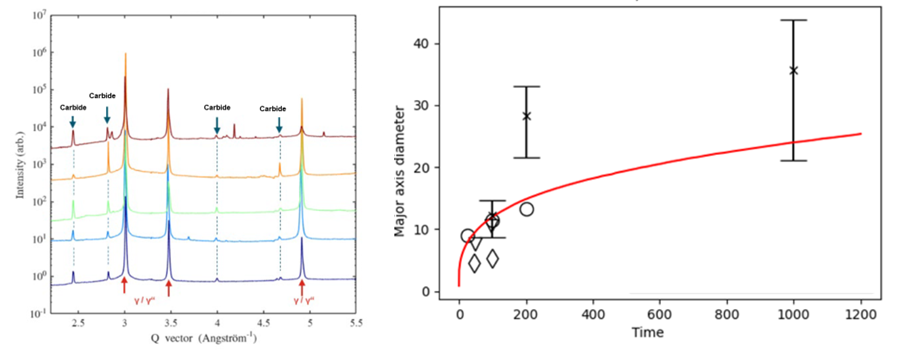
The Phenix feasibility study has explored how computational tools for the design of nickel-based superalloys can become more accurate. The results provide new insights into precipitation hardening and lay the foundation for faster and more cost-effective development of high-performance materials for future energy and transport applications.
Nickel-based superalloys are used in demanding environments where materials must withstand high temperatures and high mechanical loads. They are important in sectors such as aviation and power generation and are also relevant for emerging applications in bioenergy and geothermal systems.
In Phenix (Precipitation hardening design for next generation of endurant Ni-base super alloys), researchers focused on improving the understanding and prediction of precipitation hardening in nickel-based superalloys. Precipitation hardening occurs when fine nanoscale particles form in the material’s matrix. These particles hinder dislocation movement, which means that higher stress is required for deformation. The result is increased strength and hardness.
A key challenge is that today’s computational models for precipitation-hardened nickel-based superalloys still have limited accuracy, particularly when predicting precipitation kinetics and volume fractions. At the same time, there is a lack of statistically representative experimental validation data showing how nanoscale precipitates develop during heat treatment.
Better computational tools could significantly reduce both development time and cost. They could also make it possible to evaluate the robustness of material compositions and processes in ways that are difficult to achieve through experiments alone.
“The project’s main goal was to identify and validate how computational tools for the design of nickel-based superalloys can be improved by integrating simulations with advanced experimental characterisation,” says Zhangting He, researcher at Swerim and project manager for Phenix.
The project identified several challenges. The precipitation process is complex, with several phases, small particle sizes and high volume fractions, which makes experimental analysis difficult. There were also limitations in detecting nanoscale precipitates, especially in the early stages of the process. In addition, the project observed differences between simulation results and experimental data, particularly regarding volume fractions.
The consortium brought together industrial partners, software developers and a research institute. The industrial partners contributed materials and defined application needs, giving the project a clear industrial anchoring. Thermo-Calc provided modelling tools and expertise, while Swerim carried out experiments at large-scale research facilities, performed data analysis and developed methods for measuring nanoscale precipitates. Swerim also worked with industrial partners on laboratory-based experiments and analyses that complemented the measurements at research facilities.
Together, the consortium was able to identify important gaps in current modelling tools and define directions for future work.
The project had two main parts: measurements at large-scale research infrastructures and modelling of precipitation-hardened materials. Among the most important results are a better understanding of how large-scale research facilities can be used to characterise nickel-based superalloys, the identification of key weaknesses in existing modelling tools, and recommendations for how computational tools for precipitation modelling can be improved.
The results contribute to a deeper understanding of precipitation kinetics in early stages and of co-precipitation of primary and secondary phases.
“The project has also generated validated experimental data that can be used to improve and calibrate future models for nickel-based superalloys,” says Zhangting He.
Several unexpected observations were also made during the project. Among other things, the team noted significant differences between predicted and measured volume fractions of precipitates. The results also indicated that precipitation behaviour is slower and more complex than previously expected. In addition, the project confirmed that different scattering techniques are needed depending on the alloy composition.
The results will now be used to further develop and improve computational tools, with a focus on expanding their valid composition range and creating more accurate descriptions of precipitation mechanisms and kinetics in nickel-based superalloys.
A full-scale follow-up project, RePhenix (Reliable Modelling Approach for Designing Precipitation Hardening in Next-Generation High-Endurance Ni-Based Superalloys), has already been initiated within Swedish Metals & Minerals. Building on the results from Phenix, the project will further improve the computational tools and develop more accurate validation data using the knowledge generated through measurements at large-scale research facilities.
“The aim is to both improve the computational tools and develop even more accurate validation data, based on the knowledge generated through the measurements at the large-scale research facilities,” says Zhangting He.
A new partner with expertise in atom probe tomography has also joined the consortium. In the long term, the validated modelling tools are expected to be implemented in software and used by industrial partners for direct application in alloy design and process optimization.
Phenix was carried out as a feasibility study within Swedish Metals & Minerals. The results are now being developed further in the full-scale project RePhenix.