Building Capacity to Innovate – Seven pathways from Swedish mining ecosystem
News
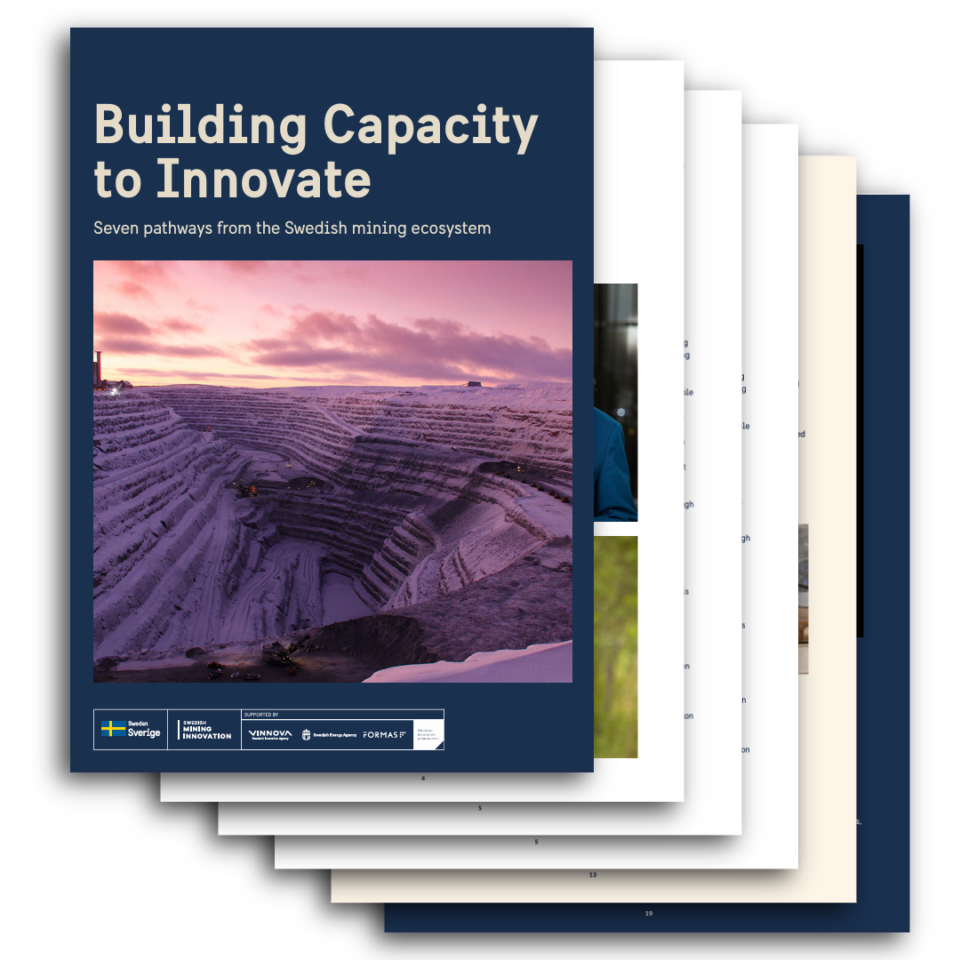
Building Capacity to Innovate
Swedish Mining Innovation was the Strategic Innovation Programme for the Swedish mining and metal-producing industry, operating for twelve years from 2013 to 2025. The programme brought together actors from industry, academia, research institutes, SMEs and the public sector to strengthen innovation, competitiveness and sustainable development across the mining and minerals sector.
Although the programme has now ended, its results, publications and experience remain available. During 2026, material will continue to be accessible through swedishmininginnovation.se, while the development of Sweden’s mining and materials ecosystem continues through initiatives including Swedish Metals & Minerals.
As part of its concluding work, Swedish Mining Innovation has developed the handbook Building Capacity to Innovate, bringing together practical lessons from twelve years of collaborative innovation in the Swedish mining and minerals ecosystem. Innovation is often presented through individual projects, new technologies or successful collaborations. Much less attention is given to what makes these achievements possible in the first place. The handbook was created to contribute that perspective.
Foreword
Building Capacity to Innovate brings together practical experience from collaborative innovation in one of the world’s most technology-intensive and sustainability-driven industrial sectors. Rather than documenting a programme or presenting a new methodology, it distils recurring patterns that helped strengthen an innovation ecosystem over time. The seven pathways described in these pages are not theoretical models. They are practical lessons drawn from experience and refined through continuous collaboration between industry, academia, public organisations and society.
Although these experiences originate in the Swedish mining and minerals sector, this handbook is not written exclusively for mining, nor only for Sweden. The challenges of accelerating innovation while navigating increasing complexity are shared across industries and regions. Whether the ambition is to strengthen industrial competitiveness, support the green transition, build regional innovation capacity or improve collaboration between public and private actors, many of the underlying questions are remarkably similar.
There is no universal blueprint for innovation. Every ecosystem is shaped by its own history, institutions and culture. The intention of the handbook is therefore not to offer solutions to be copied, but practical perspectives that others can adapt to their own circumstances. Swedish Mining Innovation hopes it will serve as a source of inspiration, a tool for reflection and a starting point for discussion among programme leaders, policymakers, researchers, companies, innovation agencies and regional actors working to strengthen collaborative innovation.
The experiences presented in the handbook build on a long tradition of collaboration between industry, research organisations and public actors. Swedish Mining Innovation built on this foundation by strengthening collaboration, broadening participation and creating new connections across organisational boundaries.
Looking back, many of the programme’s most valuable outcomes could not have been planned in advance. New partnerships emerged, priorities and available instruments evolved, failures provided learning and external developments reshaped the innovation agenda. The ability to adapt while maintaining a shared long-term direction proved just as important as any individual project or technology.
That may also be the handbook’s most important message. Innovation ecosystems are not built through isolated initiatives. They evolve through sustained collaboration, shared learning and the continuous strengthening of relationships between people, organisations and knowledge.
If the reflections collected in the handbook help others accelerate that process in their own context, it will have achieved its purpose.

LTU, Photo: Tomas Bergman
Pär Weihed
Professor and Pro Vice Vice-Chancellor,
Luleå University of Technology and
first Programme Director, Swedish Mining Innovation

LTU, photo: Magnus Stenberg
Charlotte Andersson
Associate Professor, Luleå University of Technology
Final Programme Director, Swedish Mining Innovation

LKAB, photo: Viveka Österman
Jenny Greberg
VP Technology LKAB, and Chair Svemin Research &
Innovation Committee
